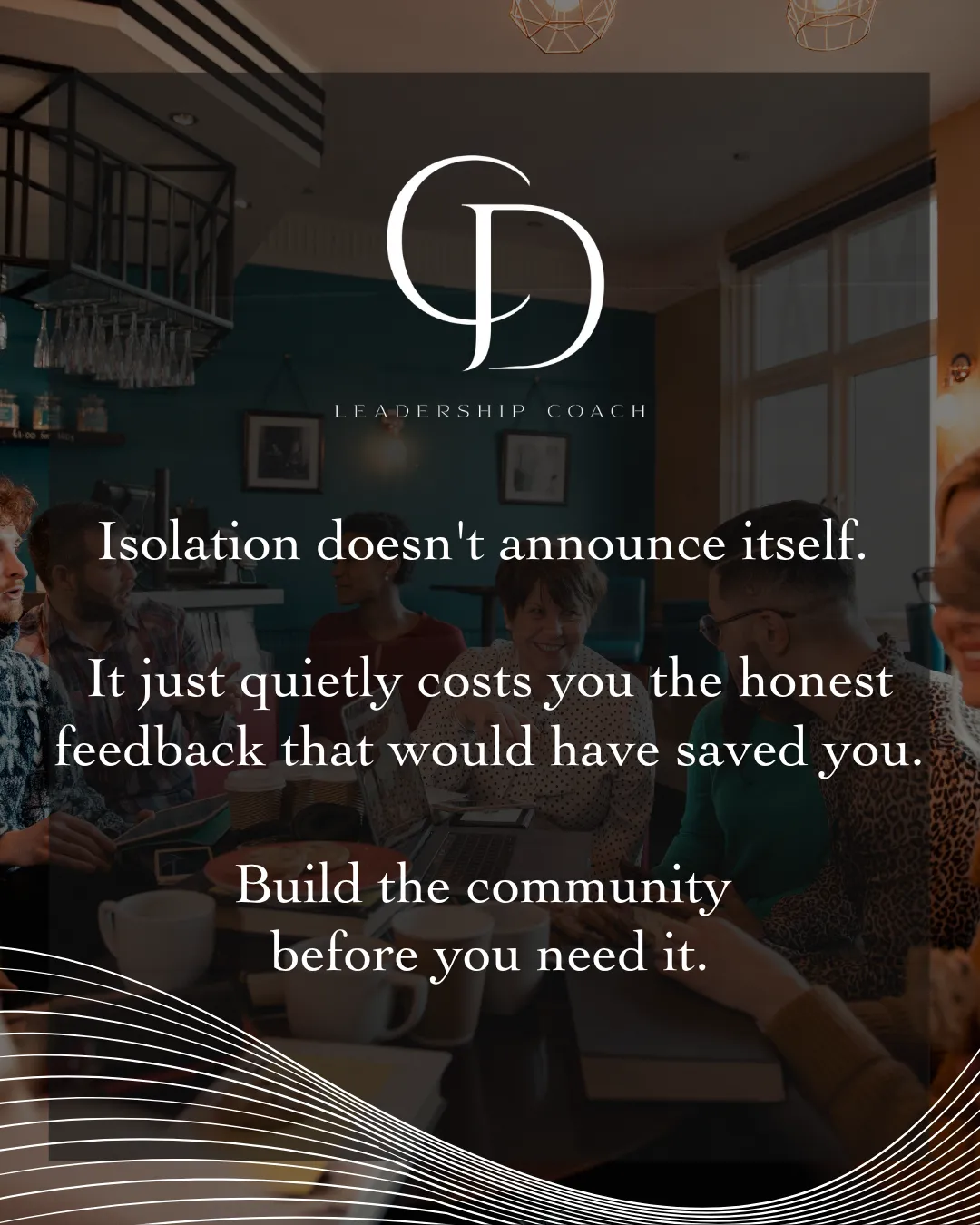
Do you have a trusted community?
Why Community Is Rated Number One
The Strategic Asset That Never Appears on the Balance Sheet
Every serious executive invests in the things that drive performance: talent acquisition, process improvement, technology infrastructure, and strategic partnerships. These are legitimate and necessary investments. But the highest-leverage asset in any leader's development portfolio rarely appears on a spreadsheet.
It is community. Not the performative networking version. Not the industry conference version where business cards are exchanged and relationships evaporate by the following Monday. Genuine community: the kind built on shared values, sustained over time, anchored in mutual trust and honest accountability.
"All the believers were together and had everything in common." — Acts 2:44
Why Isolation Is a Leadership Risk Factor
Leadership isolation is not just an emotional inconvenience. It is a documented organizational risk. Leaders without a trusted community make worse decisions. They receive less honest feedback, which means their blind spots go uncorrected longer. They are more susceptible to the kind of slow ethical drift that rarely announces itself but often ends careers.
The research on corporate governance failures consistently identifies isolation as a contributing factor. Leaders who surround themselves only with people who need their approval, or who build no meaningful relationships outside their organizational role, lose access to the honest input that calibrates judgment.
What the Early Church Got Right About Community
The early church, described in the book of Acts, is one of history's most remarkable examples of community architecture. They shared resources, held each other accountable, developed leaders from within, and created a culture so distinct from the surrounding world that it attracted attention and allegiance from thousands who encountered it.
What made that community compelling was not its program. It was its people, specifically the quality of their relationships and the shared conviction that drove it. The watching world said, remarkably, look how they love one another.
That quality of community is available to the executive who builds it with intention. And when it exists inside an organization, it produces a culture that competitors cannot replicate, because it cannot be bought. It has to be built.
Building High-Trust Community as a Leadership Practice
For the executive leader, building genuine community begins with vulnerability. Not the staged vulnerability of the carefully crafted leadership story, but the real kind: admitting uncertainty to your peers, asking for input before you have the answer, showing up to a room of other leaders as a learner rather than an authority.
This is the culture that, when modeled at the top, cascades through an entire organization. Leaders who are secure enough to be honest create permission for honesty at every level. And organizations saturated with honest communication make better decisions, resolve conflicts faster, and retain the people who matter most.
"By this everyone will know that you are my disciples, if you love one another." — John 13:35
The Executive Who Invests in Community Builds Something Lasting
The organizational legacies that endure are never purely structural. They are cultural. They exist in the quality of relationships, the depth of trust, and the shared sense of purpose that persists long after the strategy deck has been revised.
Invest in community with the same seriousness you bring to every other strategic priority. Find your people, build your culture, and protect it. It may be the most important leadership investment you ever make.
* * *
What Would Change If You Led Differently?
This is exactly the kind of question we work through together in my executive coaching packages. Deep work. Real results. Lasting change.
Invest in a coaching package and lead at a higher level. https://corajdugan.com/mor-coaching